
China Historical Overview

MAJOR CHINESE HISTORICAL PERIODS
Prehistoric China: This period refers to the earliest human settlements and cultures in China, dating back thousands of years before written records. It includes the Neolithic period and the emergence of early agricultural societies.
Ancient China: This period encompasses the legendary Xia Dynasty (c. 2070-1600 BCE) and the recorded history of China beginning with the Shang Dynasty (c. 1600-1046 BCE) and the subsequent Zhou Dynasty (1046-256 BCE). It includes the development of early Chinese civilization, the rise of feudalism, and the philosophical schools of Confucianism and Daoism.
Imperial China: This period encompasses the long span of dynastic rule in China, characterized by centralized imperial governance. Major dynasties include the Qin Dynasty (221-206 BCE), Han Dynasty (206 BCE-220 CE), Tang Dynasty (618-907 CE), Song Dynasty (960-1279 CE), Ming Dynasty (1368-1644 CE), and Qing Dynasty (1644-1912 CE). Imperial China witnessed significant achievements in arts, literature, technology, and governance.
Republican China: This period refers to the early 20th century, marked by the overthrow of the Qing Dynasty and the establishment of the Republic of China in 1912. It was a time of political and social change, with various factions vying for power.
People's Republic of China: This period began with the founding of the People's Republic of China in 1949 and continues to the present day. It encompasses the rule of the Chinese Communist Party and significant events such as the Cultural Revolution, economic reforms under Deng Xiaoping, and China's emergence as a global economic power.
This is just ONE of the many ways to view Chinese History through periods. But provides a good overview.
SOME OF THE PERIODS OF DISUNITY
Warring States Period (475-221 BC): The Zhou Dynasty (1046-256 BC) was the longest-lasting dynasty in Chinese history, but it eventually collapsed into a period of 7 warring states. This period was marked by political instability, warfare, and economic decline.
Three Kingdoms Period (220-280 AD): After the fall of the Han Dynasty (206 BC-220 AD), China was divided into three kingdoms: Wei in the north, Shu in the west, and Wu in the south. This period was marked by constant warfare and political intrigue.
Southern and Northern Dynasties (420-589 AD): After the fall of the Jin Dynasty (265-420 AD), China was divided into two regions: the north and the south. The north was ruled by a series of short-lived dynasties, while the south was ruled by the Liang, Chen, and Sui dynasties. This period was marked by political instability, warfare, and economic decline.
Five Dynasties and Ten Kingdoms (907-960 AD): After the collapse of the Tang Dynasty (618-907 AD), China was divided into 5 short-lived dynasties and 10 kingdoms. This period was marked by constant warfare and political intrigue.
CHINESE PHILOSOPHY/RELIGION
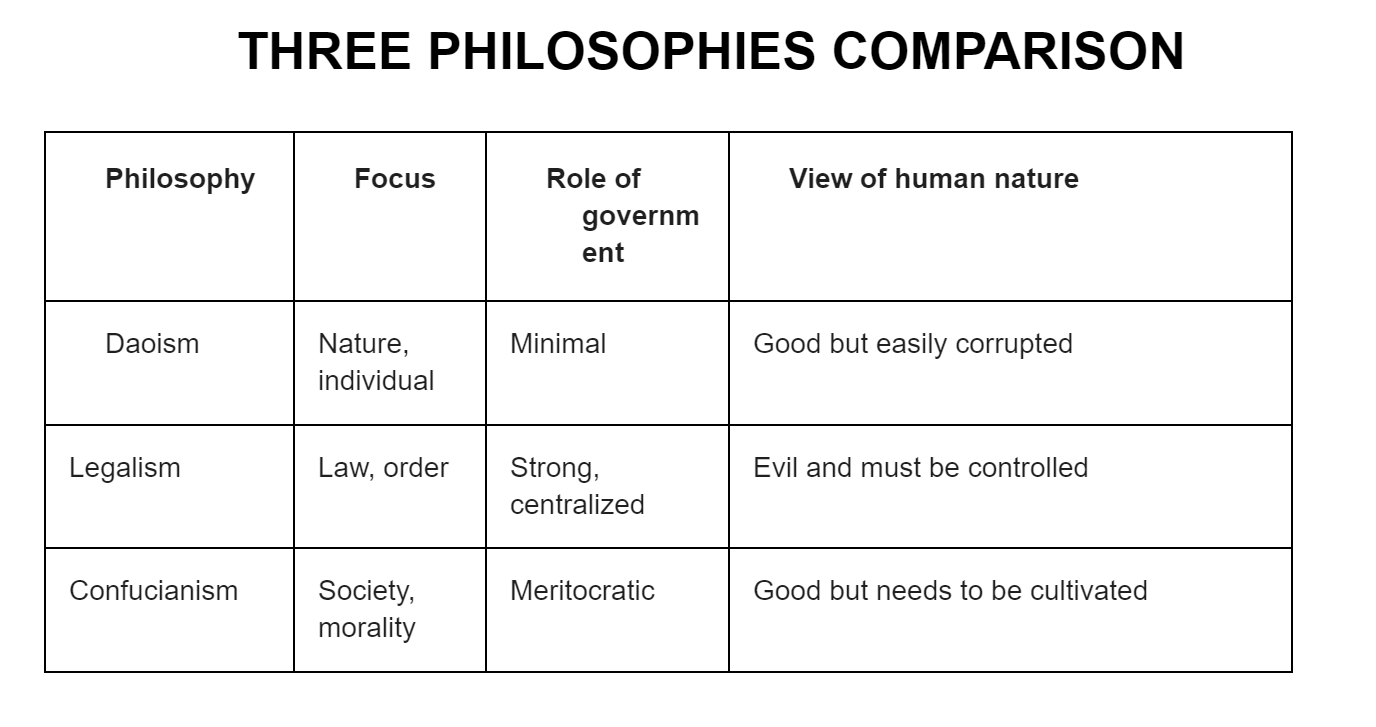
Daoism, Legalism, and Confucianism are three major philosophical and ethical systems that have greatly influenced Chinese history and culture. Each of these philosophies emerged in distinct historical contexts and offered different perspectives on governance, social order, and personal conduct.
Daoism (also spelled Taoism):
Context: Daoism emerged during the Zhou Dynasty (1046-256 BCE), a period of political fragmentation and social unrest. It was developed by philosophers such as Laozi and Zhuangzi, who sought harmony with the natural world and advocated for a simpler, intuitive way of living.
Beliefs and Importance: Daoists emphasized the concept of the Dao (or Tao), which can be understood as the natural order or the way of the universe. They encouraged individuals to follow the path of least resistance (wuwei) and embrace spontaneity, in contrast to rigid social conventions. Daoism emphasized balance, self-cultivation, and a deep connection with nature. It had a significant impact on Chinese art, literature, medicine, and the pursuit of personal enlightenment.
Legalism:
Context: Legalism emerged during the Warring States Period (475-221 BCE), a time of intense conflict and political instability. It was developed by thinkers such as Han Feizi and Li Si, who sought a solution to the chaos and believed in strict rule by law.
Beliefs and Importance: Legalists emphasized the importance of a strong, centralized state governed by a system of clear laws and strict punishments. They believed that human nature was inherently selfish and that people could be motivated through rewards and punishments. Legalism emphasized practical governance, military strength, and a focus on efficient administration. While Legalism was influential in shaping the Qin Dynasty's authoritarian rule, its harsh and rigid approach to governance faced criticism for its lack of consideration for human values and individual liberties.
Confucianism:
Context: Confucianism originated during the late Zhou Dynasty and reached its peak influence during the Han Dynasty (206 BCE-220 CE). It emerged in a period of social and moral crisis, when the traditional social order was disrupted, and there was a need for ethical guidance.
Beliefs and Importance: Confucianism, founded by Confucius (Kongzi), emphasized moral virtue, social harmony, and the cultivation of personal ethics. It emphasized the Five Relationships (such as ruler-subject, father-son, husband-wife) as the basis of social order and stressed the importance of filial piety and respect for authority. Confucianism advocated for the development of the junzi (gentleman) through education, ethical behavior, and adherence to rituals. It played a crucial role in shaping Chinese society, governance, and education systems for centuries, promoting social stability and emphasizing moral values.
These three philosophies have shaped Chinese history by influencing governance, moral values, social order, and individual conduct. Daoism provided a spiritual and philosophical perspective, Legalism offered pragmatic approaches to governance, and Confucianism emphasized ethics and social harmony. Together, they formed a rich tapestry of ideas that influenced various aspects of Chinese culture, literature, art, and the development of institutions throughout history.
THE MIDDLE KINGDOM
The concept of China as the Middle Kingdom refers to the traditional belief that China is the cultural and political center of the world.
It developed during the Zhou Dynasty and was reinforced by subsequent dynasties.
China saw itself as the central and most civilized nation, with the Chinese emperor considered the "Son of Heaven" and holding supreme authority.
Other nations were perceived as "barbarian" lands, and China regarded them as tribute states expected to pay tribute and show deference to the Chinese emperor.
Even England was seen as barbarians in the 19th century
This concept was integral to China into the 19th century in a VERY real way
The concept led to the establishment of tributary relationships, where foreign powers acknowledged China's superiority and sought its favor.
Regular trade is not possible because China desires nothing, and saw no other nation as equal
However, this perception was not universally accepted by neighboring states, particularly those with their own powerful civilizations and cultures.
THE QING DYNASTY
Founded in 1644 by the Manchus, who were a minority group from Manchuria
In Manchuria, northern China
Lasted for over 260 years, making it the longest-reigning dynasty in Chinese history
At its peak, the Qing dynasty controlled a vast empire that stretched from Manchuria in the north to Tibet in the south, and from Mongolia in the east to Xinjiang in the west
Basically the expense of today
The Qing dynasty was a time of great economic and cultural prosperity for China
Until the end
However, the dynasty also faced a number of challenges, including the Opium Wars, the Taiping Rebellion, and the Boxer Rebellion
The Qing dynasty collapsed in 1912, after the Xinhai Revolution
EAST MEETS WEST: ENGLAND AND CHINA
In 1793, the British diplomat George Macartney led a diplomatic mission to China with the aim of establishing better trade relations and securing greater access for British merchants.
Macartney's mission included a meeting with the Qianlong Emperor of the Qing Dynasty, the ruler of China at the time.
The meeting took place in September 1793 in the imperial summer palace in Chengde, northeast of Beijing.
Macartney and his delegation presented gifts to the emperor, including scientific instruments, textiles, and other Western goods.
Macartney hoped to negotiate a more favorable trade agreement and the establishment of a British embassy in Beijing.
The emperor firmly maintained China's position as the dominant power and emphasized China's self-sufficiency
China viewed British as barbarians, no need for British “barbarian” goods
Only interacted with other nations are tributary system
Macartney's mission ended without achieving its primary objectives, and the British did not secure significant trade concessions from China.
The meeting between Macartney and the Qianlong Emperor highlighted the cultural and diplomatic differences between China and the West at that time.
The event has since been regarded as a symbol of the challenges faced by Western powers in their attempts to establish diplomatic and trade relations with China during the Qing Dynasty.
THE OPIUM WARS
First Opium War (1839-1842):
The British East India Company (EIC) had been smuggling opium into China for decades, and the Chinese government had tried to stop the trade.
They did this after they couldn’t negotiate with the Chinese
In 1839, the Chinese government sent Lin Zexu, a high-ranking official, to Guangzhou to destroy the opium stockpiles and expel the British merchants.
The British refused to comply, and the First Opium War began.
The British navy defeated the Chinese forces, and the Treaty of Nanjing was signed in 1842.
The treaty forced China to cede Hong Kong to the British, open five ports to foreign trade, and pay an indemnity.
Second Opium War (1856-1860):
The Second Opium War was fought between China and a coalition of British and French forces.
The war was sparked by a dispute over the Arrow, a ship that was flying the British flag but was suspected of being a pirate ship.
The British and French forces attacked Chinese forts and cities, and the Chinese government was defeated.
The Treaty of Tianjin was signed in 1860, which further opened China to foreign trade and gave foreigners more privileges.
The Opium Wars were a humiliating defeat for China and led to a period of decline for the country. The wars also opened China to foreign influence and led to the introduction of Western ideas and technology.
Here are some of the consequences of the Opium Wars:
China was forced to open its markets to foreign trade. This led to the influx of cheap foreign goods, which damaged China's own industries.
Total backwards
For most of human history, Middle Ages into the 19th century, China known as EPITOME OF QUALITY, even in Europe
China was forced to cede territory to foreign powers. This included Hong Kong, which was ceded to the British, and parts of Manchuria, which was ceded to the Russians.
Manchuria being a part of China that
China was forced to pay indemnities to foreign powers. This was a huge financial burden for China, and it took many years for the country to pay off the debt.
China's prestige was damaged. The Opium Wars showed that China was no longer a powerful and independent country.
China began to modernize its military and its economy. This was an attempt to catch up with the West and to prevent further humiliations.
And the Japanese
The Opium Wars led to the rise of Chinese nationalism. This was a feeling of anger and resentment towards the West, and it led to a number of uprisings and rebellions
The Opium Wars were a turning point in Chinese history. They marked the beginning of China's decline as a major power and the start of its modernization.
QING DYNASTY WEAKENS
Influence of European culture and goods: The Qing dynasty was slow to adopt Western technology and ideas, such as the steam engine and the telegraph. This led to a growing gap between China and the West. The West had more advanced technology and weapons, which gave it an advantage in trade and warfare. This gap also led to a loss of confidence among the Chinese people, who began to believe that China was no longer a great power.
Resistance to modernization weakened China’s chances
Qing considered themselves innately superior so did not modernize when they had the chance
Leads to relative loss of power to West, but also to the early modernizing Japan
The Opium Wars: The Opium Wars were a series of wars fought between China and the British Empire in the 19th century. The wars were caused by the British desire to trade opium in China, which was illegal at the time. The Qing dynasty was defeated in the wars, and this led to a loss of prestige and a weakening of the dynasty's authority. The wars also opened China to foreign trade and investment, which led to an influx of foreign goods and ideas, which some Chinese saw as a threat to their culture.
Banner armies: The Qing dynasty's military was composed of banner armies, which were made up of Manchu and Mongol soldiers. These armies were loyal to the Qing emperor, but they were also seen as outsiders by the Han Chinese majority. This made it difficult for the Qing dynasty to maintain control over the Han Chinese population. The Han Chinese majority felt that the bannermen were not interested in their welfare and that they were only interested in protecting the interests of the Manchu minority.
No legitimacy of Emperor
Sometimes did not even fight for the Emperor
Civil wars: The Qing dynasty was plagued by civil wars throughout its history. These wars weakened the dynasty and made it difficult to maintain control over the country. Some of the most notable civil wars of the Qing dynasty include the Taiping Rebellion (1850-1864) and the Boxer Rebellion (1900).
Warlords: In the late 19th and early 20th centuries, China was plagued by warlordism. Warlords were military commanders who controlled territory in different parts of the country. They often fought each other for control, and they were not loyal to the Qing emperor. This made it impossible for the Qing dynasty to maintain control
19th CENTURY CIVIL WARS
Dungan Revolt
Motivation: The Dungan Revolt was motivated by a number of factors, including:
Qing government's persecution of Muslims
Growing influence of Christian missionaries in the region
Economic hardship
Details: The revolt began in 1862 in the northwestern province of Xinjiang. The rebels were mostly Muslim Dungans, who are a Turkic-speaking people. They were led by Ma Hualong, a Muslim religious leader. The rebels fought against the Qing government for five years, but they were eventually defeated in 1877.
Result: The Dungan Revolt was a major setback for the Qing government. It weakened the government's control over Xinjiang and led to an increase in foreign intervention in the region.
Peasants' War
Motivation: The Peasants' War was motivated by a number of factors, including:
Economic hardship
Qing government's corruption and inefficiency
Oppression of ethnic minorities
Details: The revolt began in 1870 in the southwestern province of Yunnan. The rebels were mostly ethnic minorities, such as the Miao and Yao people. They were led by Wu Sangui, a former Qing general. The rebels fought against the Qing government for three years, but they were eventually defeated in 1873.
Result: The Peasants' War was another major setback for the Qing government. It weakened the government's control over Yunnan and led to an increase in foreign intervention in the region.
Nian Rebellion
Motivation: The Nian Rebellion was motivated by a number of factors, including:
Economic hardship
Qing government's corruption and inefficiency
Oppression of peasants
Details: The revolt began in 1853 in the northern province of Henan. The rebels were mostly peasants who were impoverished and discontent with the Qing government. They were led by Zhang Luoxing, a former Qing soldier. The Nian rebels fought against the Qing government for fifteen years, but they were eventually defeated in 1868.
Result: The Nian Rebellion was a major setback for the Qing government. It weakened the government's control over northern China and led to an increase in foreign intervention in the region.
Taiping Rebellion
Motivation: The Taiping Rebellion was motivated by a number of factors, including:
Economic hardship
Qing government's corruption and inefficiency
Oppression of peasants
Religious fervor
Details: The revolt began in 1850 in the southern province of Guangxi. The rebels were led by Hong Xiuquan, a Hakka Christian convert who claimed to be the younger brother of Jesus Christ. The Taiping rebels fought for the establishment of a utopian society based on Christian principles. The Taiping Rebellion was the largest civil war in Chinese history, and it lasted for fourteen years. The rebellion eventually collapsed in 1864, but it left millions of people dead and caused widespread devastation.
Result: The Taiping Rebellion was a major setback for the Qing government. It weakened the government's control over southern China and led to an increase in foreign intervention in the region. The rebellion also had a profound impact on Chinese society and culture. It led to the rise of new social classes and the breakdown of traditional social structures.
The revolts and Civil Wars were a result of a weakened central government. As the Qing could not fight off the westerners they appeared weak, and a feedback loop was created as more minorities and lesser powers pressed their opportunity. Some of these revolts centered on foreign technology and belief, like the Taiping rebellion. As the Chinese government appeared weak in the face of western Christians, an appeal to Christianity for a replacement power makes sense.
WHY THE COMMUNISTS WON THE CIVIL WAR
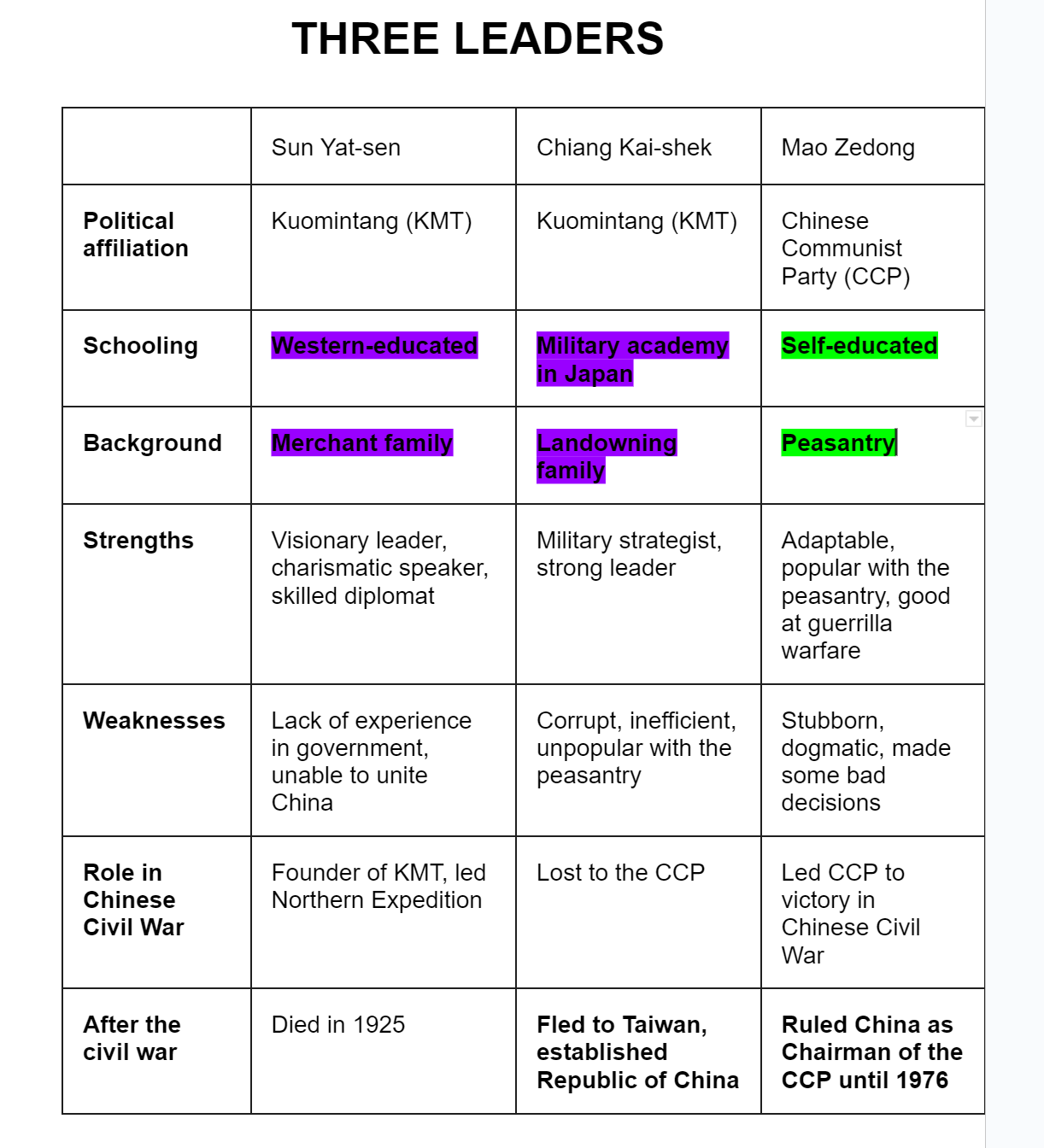
Peasant support: The CCP had the support of the peasantry, who made up the majority of the Chinese population. The CCP promised land reform and other economic benefits to the peasants, which appealed to their desire for a better life. The KMT, on the other hand, was seen as corrupt and oppressive by many peasants. They were also known to carry out massacres of civilians, which further alienated the peasantry.
Strategic errors: The KMT made a number of strategic errors during the Civil War. For example, they concentrated their forces in the cities, which made them vulnerable to the CCP's guerrilla attacks. They also alienated the peasantry by continuing to collect high taxes and by refusing to implement land reform.
International support: The CCP received support from the Soviet Union, which provided them with military aid and training. The KMT, on the other hand, was largely cut off from international support after the United States withdrew its support in 1949.
Guerrilla warfare: The CCP was skilled in guerrilla warfare, which allowed them to fight against the KMT's larger and better-equipped army. The CCP was able to operate in remote areas and launch surprise attacks, which wore down the KMT's forces.
This document was created with AI tools and my own commentary and changes, which may or may not be correct in all cases. Please verify information
This was great (along with the podcast).
(the podcast for comment enjoyers): https://podcasters.spotify.com/pod/show/biting-the-bullet/episodes/Samuel-Urban-on-China-Ep--201-e26eg20
OK, your last podcast https://www.buzzsprout.com/2090140/13185697-isl-july-6-2023.mp3 with Kyle. Clearly you have to have the last bits of liberalism and big "L" libertarianism beaten out of you.
Birthright Citizenship is an intentional misinterpretation of the 14th amendment https://www.americanthinker.com/articles/2018/10/ending_birthright_citizenship.html . Read the rest of their articles to understand just how wrong you and everybody who thinks anyone who manages to pop out a kid here should be allowed to chain migrate https://www.ecosia.org/search?tt=e8eb07a6&addon=brave&q=americanthinker.com%20%20%22birthright%20citizenship%22 Immigrants also vote left/Communist, you can't have representative government for very long under that condition.
Immigrants use welfare at higher rates than natives, they are a net negative https://www.ecosia.org/search?tt=e8eb07a6&q=Immigrants%20use%20welfare%20at%20higher%20rates%20than%20natives&addon=brave Please inform Kyle, because his take is so retarded it gives people with developmental disabilities a bad name.
"Free trade is a good thing" is a lie, because it everywhere and always assumes non hostile trading partners, and requires labor to cross borders to work, among other highly negative effects https://voxday.net/tag/free-trade/
Other than that, some of the takes in your conversation were pretty good.